Inspirations/Materials
Materials · 8 min read
Plywood, MDF and particle board: where each one belongs
The argument is not which is best. It is which belongs where.
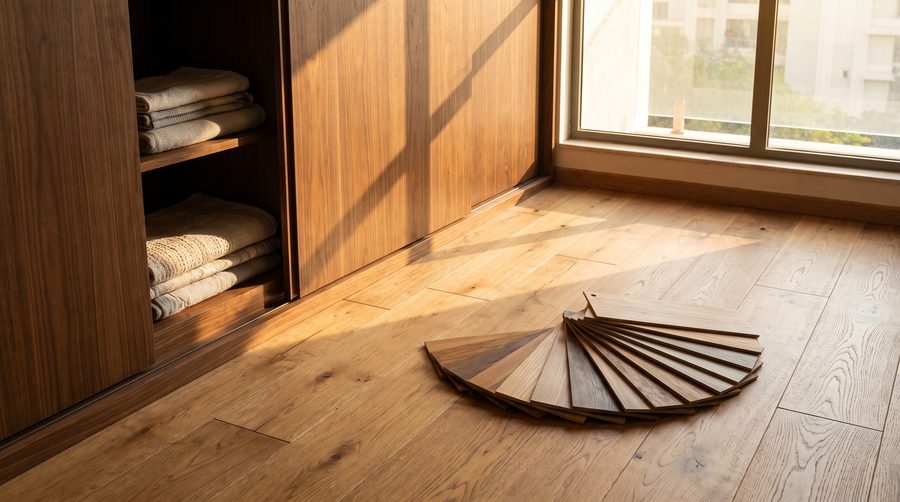
Plywood is layered veneer, strong across its face, holds a screw well and tolerates moisture in its boiling-water-proof grade. MDF is uniform, machines beautifully for routed and moulded shutters, takes a spray finish flawlessly and swells irreversibly if it gets wet. Particle board is cheap, stable in dry conditions and unforgiving of both water and repeated screwing.
So: BWP plywood under the sink and in the bathroom vanity, wherever water is a matter of when rather than if. MDF for shutters that are moulded or lacquered, where a flawless face matters more than moisture. Particle board for interiors of dry wardrobes if the budget genuinely demands it, and nowhere else.
Check the grade stamp, not the salesperson. BWR and BWP are different things, and MR grade — moisture resistant — is a much weaker claim than the name suggests. If the board is unmarked, treat it as commercial grade regardless of what the invoice says.
For flooring, the useful distinction is wear layer thickness. An engineered board with a 3mm or thicker wear layer can be sanded and refinished later; a 0.6mm veneer cannot, and when it wears through the whole floor is done.
Plywood is layered veneer, strong across its face, holds a screw well and tolerates moisture in its boiling-water-proof grade.